

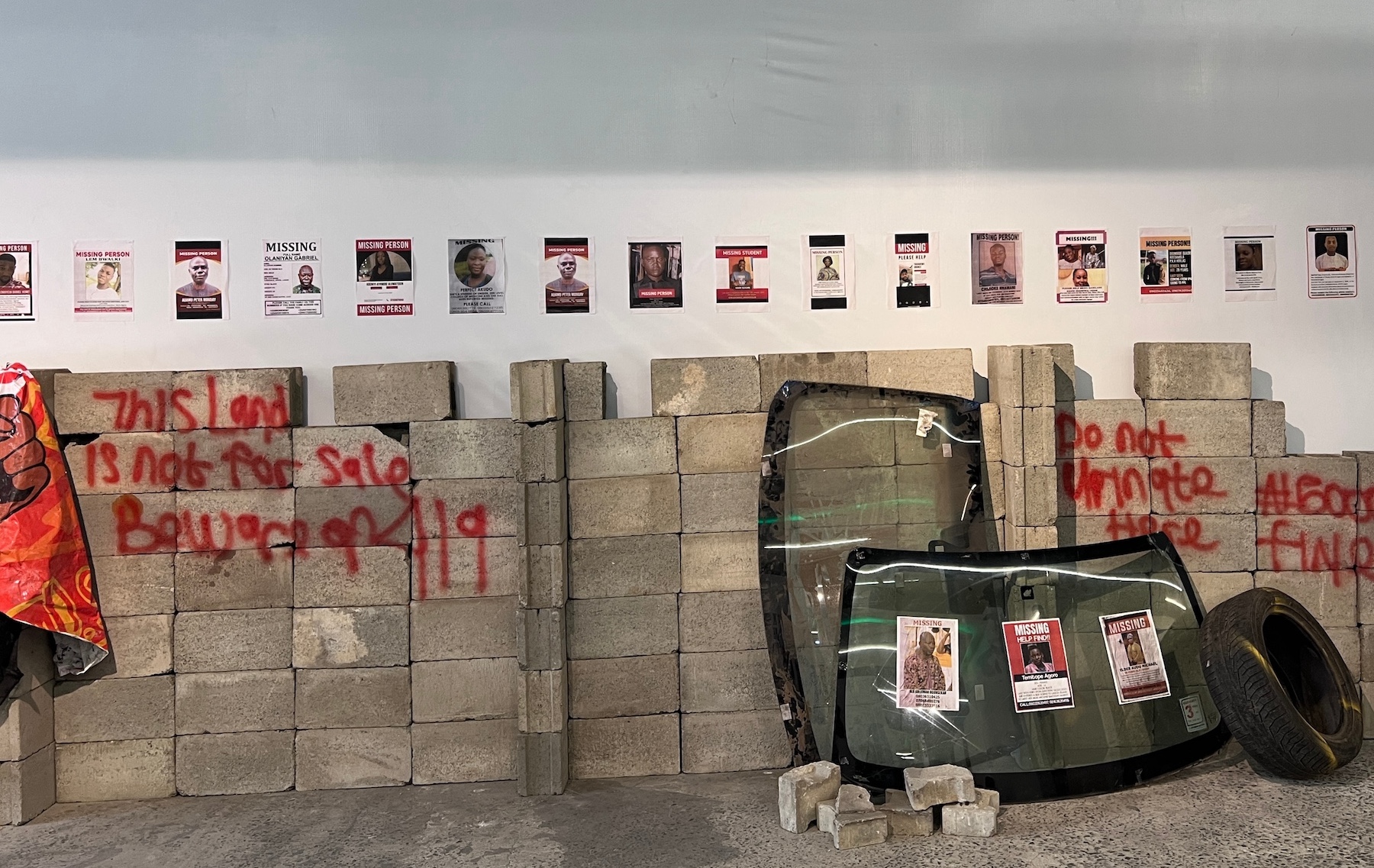
This text was submitted as a proposal to the apexart INTL26 Open Call
The Nigeria Immigration Service (NIS) intercepted six victims of human trafficking along Kankon-Owode Road, in Badagry, Lagos, Nigeria. Prior to this, on July 22, 2024, the Lagos Border Patrol Command of NIS, at Seme, in Badagry, intercepted a six-month-old baby and three other children, suspected to be victims of human trafficking.
For decades, human trafficking in Nigeria and West Africa has followed patterns of migration, displacement, and economic coercion. In 2016 alone, 602,000 Nigerians tried to migrate to Europe through the Sahara Desert, and 27,000 of these migrants died en route.
From Badagry to Cotonou, Lagos to Ghana, Sahel States to Libya, Libya to Europe, countless young people are lured by the promise of opportunity, only to find themselves commodified.
Cargo of Hope: Through the work of five artists working across installation, sculpture, performance, and participatory media, this exhibition examines how migration transforms into a system of exploitation.
Installation and performance artist Ashele Israel examines the quiet violence of absence experienced by families left behind. By recreating a modest home installation and performing the rituals expressing the grief, hope, and pain of these families, he turns waiting into a fragile ritual of permanent longing.
Multidisciplinary artist Andrew Nathan creates an installation exploring double loss. He uses a split room where farm tools float in the air and Ghana Must Go bags are scattered across the space. It tells the story of parents who sell their land and property to send a child abroad in the care of someone they barely know, hoping for a better life. Instead, the child becomes trapped in forced prostitution or drug trafficking.
Olayinka Muyideen, mixed media artist presents large scale tapestry portraying abstract human figures formed from fragmented coconut shells bind with copper wire. Missing parts and hollow spaces reflect bodily and emotional violations, addressing organ exploitation linked to human trafficking.
Ceramic artist Mariam Aliyu constructs a walk-through installation from stacked clay pots and aligned plates forming a walk-through cargo tunnel. The work reflects systems that process and transport human lives as commodities for hard labor, while many of them die along migration routes or are subjected to sexual exploitation without consent.
Contemporary artist and Curator, Paul Ayihawu installs life-sized steel silhouette sculptures of bodies along departure routes in Badagry with missing organs that show how trafficking in persons for the purpose of organ removal occurs, each labeled with a destination. Audio testimonies of survivors accompany the figures, revealing the quiet circulation of hope as a system of exploitation.
If hope is necessary for survival, what happens when it is commodified for exploitation?
The Nigeria Immigration Service (NIS) intercepted six victims of human trafficking along Kankon-Owode Road, in Badagry, Lagos, Nigeria. Prior to this, on July 22, 2024, the Lagos Border Patrol Command of NIS, at Seme, in Badagry, intercepted a six-month-old baby and three other children, suspected to be victims of human trafficking.
For decades, human trafficking in Nigeria and West Africa has followed patterns of migration, displacement, and economic coercion. In 2016 alone, 602,000 Nigerians tried to migrate to Europe through the Sahara Desert, and 27,000 of these migrants died en route.
From Badagry to Cotonou, Lagos to Ghana, Sahel States to Libya, Libya to Europe, countless young people are lured by the promise of opportunity, only to find themselves commodified.
Cargo of Hope: Through the work of five artists working across installation, sculpture, performance, and participatory media, this exhibition examines how migration transforms into a system of exploitation.
Installation and performance artist Ashele Israel examines the quiet violence of absence experienced by families left behind. By recreating a modest home installation and performing the rituals expressing the grief, hope, and pain of these families, he turns waiting into a fragile ritual of permanent longing.
Multidisciplinary artist Andrew Nathan creates an installation exploring double loss. He uses a split room where farm tools float in the air and Ghana Must Go bags are scattered across the space. It tells the story of parents who sell their land and property to send a child abroad in the care of someone they barely know, hoping for a better life. Instead, the child becomes trapped in forced prostitution or drug trafficking.
Olayinka Muyideen, mixed media artist presents large scale tapestry portraying abstract human figures formed from fragmented coconut shells bind with copper wire. Missing parts and hollow spaces reflect bodily and emotional violations, addressing organ exploitation linked to human trafficking.
Ceramic artist Mariam Aliyu constructs a walk-through installation from stacked clay pots and aligned plates forming a walk-through cargo tunnel. The work reflects systems that process and transport human lives as commodities for hard labor, while many of them die along migration routes or are subjected to sexual exploitation without consent.
Contemporary artist and Curator, Paul Ayihawu installs life-sized steel silhouette sculptures of bodies along departure routes in Badagry with missing organs that show how trafficking in persons for the purpose of organ removal occurs, each labeled with a destination. Audio testimonies of survivors accompany the figures, revealing the quiet circulation of hope as a system of exploitation.
If hope is necessary for survival, what happens when it is commodified for exploitation?
Badagry Young Contemporaries (BYC) is a creative hub based in Badagry, Lagos Nigeria, that nurtures emerging artists, curators, and cultural practitioners. Through residencies, exhibitions, workshops, and mentorship, BYC elevates local talent while engaging with global conversations in contemporary art. The collective?s work examines social, historical, and cultural narratives, fostering dialogue, experimentation, and critical reflection.
apexart’s program supporters past and present include the National Endowment for the Arts, Milton and Sally Avery Arts Foundation, the Kettering Family Foundation, the Buhl Foundation, The Martin and Rebecca Eisenberg Foundation, Bloomberg Philanthropies, Spencer Brownstone, the Kenneth A. Cowin Foundation, Epstein Teicher Philanthropies, The Greenwich Collection Ltd., William Talbott Hillman Foundation/Affirmation Arts Fund, the Fifth Floor Foundation, The Puffin Foundation, the Trust for Mutual Understanding, The Andy Warhol Foundation for the Visual Arts, and public funds from the New York City Department of Cultural Affairs in partnership with the City Council, public funds from Creative Engagement, supported by the New York State Council on the Arts with the support of the Governor and administered by LMCC, funds from NYSCA Electronic Media/Film in Partnership with Wave Farm: Media Arts Assistance Fund, with the support of the Office of the Governor and the New York State Legislature, as well as the New York State Council on the Arts with the support of Governor Kathy Hochul and the New York State Legislature.